Picture the ad. A woman in a sunny kitchen holds up a jar of face cream, leans toward the camera and says, “Okay, I’ve been using this for three weeks and my skin has never looked better.” Casual. Relatable. Shot on a phone, by the look of it.
Except she isn’t real, she’s never had skin, and there were no three weeks.
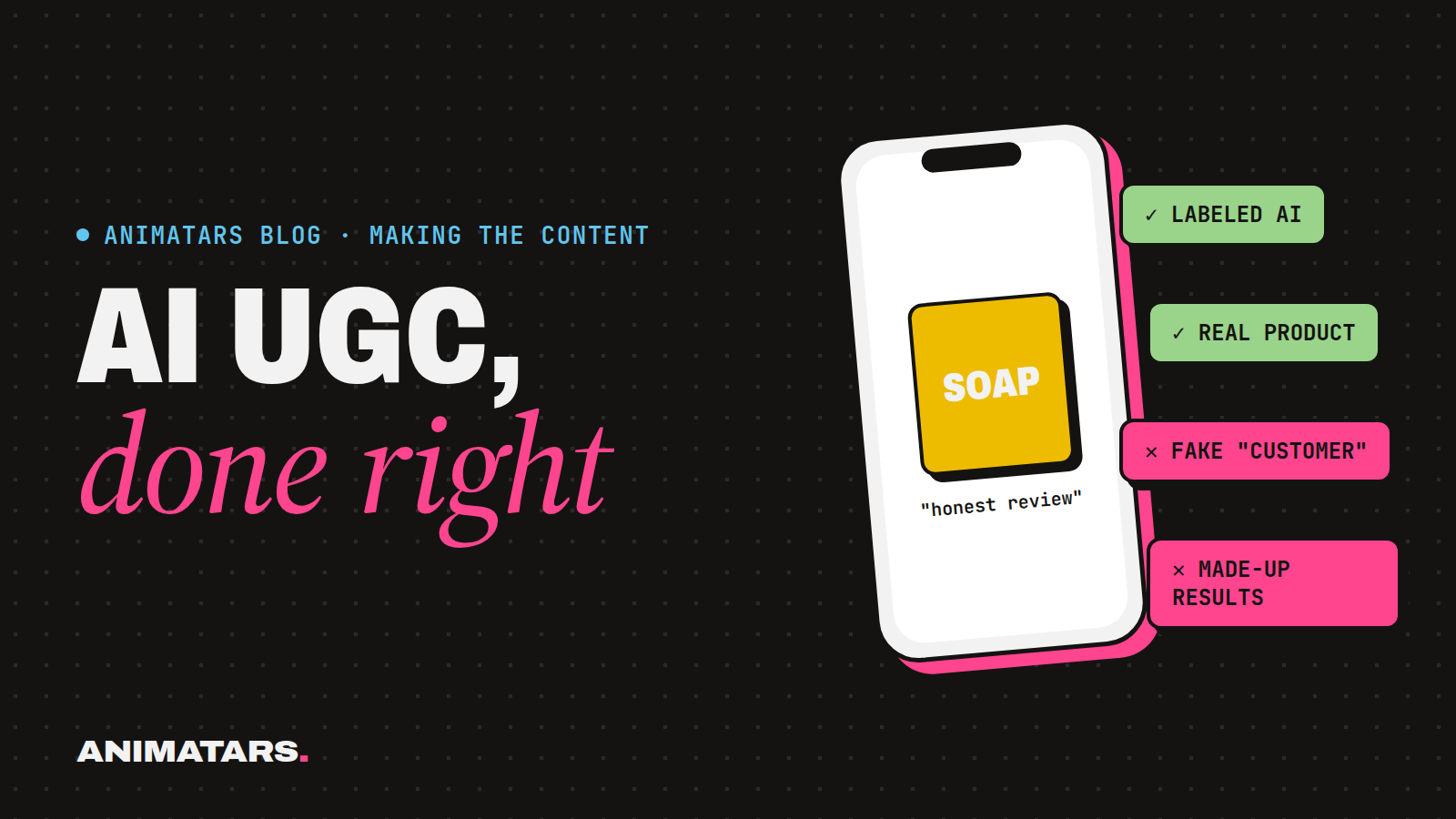
That’s AI UGC at its worst. It’s also the version most people picture when they hear the term, which is a shame, because the format can be genuinely useful when it’s done honestly. We build AI creators for a living, and we’ve thought about this a lot. Here’s what AI UGC is, the green flags that tell you it’ll work, the red flags that tell you it’ll blow up in your face, and a script template you can use today.
What is AI UGC, exactly?
UGC stands for user-generated content: the casual, filmed-on-a-phone videos real customers post about things they bought. Brands love the style because it feels like a friend’s recommendation instead of a commercial.
AI UGC borrows that look with an AI-generated presenter. Usually it’s a character image turned into a talking or moving clip with image-to-video tools (Runway and Kling are common examples), a voice from something like ElevenLabs, and a quick edit in CapCut. If you want the production side, our image-to-video AI workflow walks through it step by step.
You’ll see AI generated UGC used in three main ways:
- Brand ads: a company generates presenters to talk about its own product.
- Creator content: an AI character in a niche (home decor, cooking, fitness) shows products as part of normal posts.
- Sponsored posts: a brand pays an AI creator’s account to feature something.
The production side is the easy part. The hard part is honesty, and that’s what decides whether AI UGC ads build trust or burn it.
The one question that sorts good from bad
Before you script anything, ask: would this video still be true if everyone watching knew the presenter was AI?
If yes, you’re probably fine. If the video only works because people assume a real human had a real experience, it’s deceptive, no matter how nicely it’s lit.
Run the face cream ad through that test. “I’ve been using this for three weeks” is false the moment you know she’s AI. Now try this one: an AI character holds a peel-and-stick tile up against a kitchen backsplash and says, “Here’s how this pattern looks next to white cabinets versus wood.” Still true. Still useful. Nobody’s been misled.
Green flags: when AI UGC works
It shows, it doesn’t testify
AI characters are great at demonstrating, comparing and styling. “Three ways to style one throw blanket on a sofa” is a perfect AI UGC video. The character is a presenter, like a host on a home show. It isn’t pretending to be a satisfied customer.
The character is disclosed
The account says it’s an AI-generated creator, and the video uses the platform’s AI label where it applies. Instagram, TikTok and YouTube all have ways to label AI-generated or realistic synthetic content. The options change, so check each platform’s current settings when you upload.
The claims are about the product, not about results
“This shelf holds the weight listed on the box, here’s how to mount it” is a claim you can stand behind. “This shelf changed my life” is not. Stick to what the brand can verify and what the viewer can see.
The character fits the niche
Hazel showing a high-end look for less, built from affordable pieces, makes sense. Hazel suddenly selling protein powder doesn’t. A consistent character with a clear niche reads as a channel, not as an ad farm. Our pillar post on building a consistent AI character covers why that consistency matters.
It’s useful even if you never buy
The best test of all. If a viewer learns how to hang curtains higher to make a ceiling look taller, the video earned its spot whether or not they click the link.
Red flags: when AI UGC backfires
Fake testimonials
Anything framed as personal experience: “I tried this”, “I’ve used it for a month”, “my kids love it”. An AI character didn’t try it. This is the fastest way to lose trust and invite trouble.
Before-and-after results on bodies
Skin, weight, hair, teeth, sleep, health. An AI character showing “results” in these categories is deceptive by design, because the “after” was generated. Stay well away.
Pretending to be a customer
Some AI generated UGC is built to look like random real people reviewing a product, with no character, no account history and no label. That’s impersonating a customer, and it’s the version that gives the whole format a bad name.
Hidden sponsorship
If a brand paid for the post, say so clearly. The FTC expects paid partnerships and affiliate links to be disclosed, and that applies to AI creators as much as human ones. Use the platform’s paid partnership tools too.
The uncanny shortcut
Rushed video with warping hands, mismatched lip sync or a face that changes halfway through. Even if everything else is honest, people notice, and the comments will be about the glitch instead of the product.
Green flag or red flag? A quick sorting game
Try these before reading our answers.
- Alice shows a $40 headboard build using a specific brand of foam, sponsored by the foam company, labeled as paid.
- A faceless account posts an AI “mom” saying a supplement fixed her toddler’s sleep.
- Willow compares three renter-friendly hooks on the same wall, then links to them with affiliate links, disclosed in the caption.
- A brand runs ads with twelve different AI “customers” giving five-star reviews.
- Logan demonstrates how a new cordless drill’s clutch settings work, reading from the spec sheet, with the AI label on.
Answers: 1, 3 and 5 are green. They show, they disclose, and they don’t claim personal experience. 2 is red three times over (health claim, fake testimonial, no disclosure). 4 is red because it impersonates customers.
An honest AI UGC script you can use today
This works for most physical products, especially in home decor and DIY. Keep it around 20 to 40 seconds.
HOOK (0-3s)
"[Problem the viewer has], here's one way to fix it."
Example: "Rented apartment, sad blank wall? Here's a fix that peels off."

SHOW (3-15s)
Character demonstrates the product. Describe what we can see.
"This is [product]. It [does what], and you can see [visible detail]."

COMPARE OR STYLE (15-30s)
Two or three options, side by side, or styled in a real room.
"Here it is on a white wall... and here next to the oak shelf."

HONEST LINE (optional)
Something the brand can verify: size, material, how it comes off.

CTA
"Link's in my bio if you want the one on the left."

ON SCREEN / CAPTION
AI label on. "Paid partnership with [brand]" if sponsored.
"#ad" or the platform's partnership tag. Affiliate links disclosed.
Notice what’s missing: no “I”, no “my results”, no “I’ve been using”. The character is a host, and hosts can be charming without pretending.
If a brand asks you to cross the line
It’ll happen. A brand will love your AI creator and ask for “a quick review, just say you loved it”. You can say no and offer the honest version instead: a demo, a styling video, a comparison. Most brands accept it once they see the script, and the ones that don’t are telling you something useful about working with them. Our guide to AI influencer brand deals includes a pitch template that sets these terms up front.
And for the platform side of labeling, see how to label AI content on Instagram, TikTok and YouTube.
FAQ
What is AI UGC?
AI UGC is short, casual video in the style of user-generated content, made with an AI-generated presenter instead of a real person filming themselves. Brands and creators use it for product demos, explainers and ads.
Are AI UGC ads allowed?
Generally yes, as long as they aren’t deceptive. Label the AI-generated content using each platform’s current tools, disclose paid partnerships, and never present an AI character as a real customer with real results.
Can an AI character give a product review?
Not honestly in the usual sense, because the character never used the product. It can show the product, explain features, or share styling ideas. A first-hand testimonial is where it crosses the line.
Do AI UGC videos perform as well as real ones?
Nobody can promise that. Some do well, some don’t, and it depends on the hook, the product and how honest the video feels. Test small and watch your comments as closely as your views.
The short version
AI UGC is a presenter format. Treat your AI character like a host who shows, compares and styles, label it, disclose any money, and it can be a useful part of your content. Treat it like a fake customer and it’ll cost you the trust you spent months earning.
We’re building the Studio Pack to help with exactly this: Character Keys so your host stays consistent, video prompts in the Prompt Vault, and Creator School lessons on doing sponsored content the honest way. Join the beta to get in early.