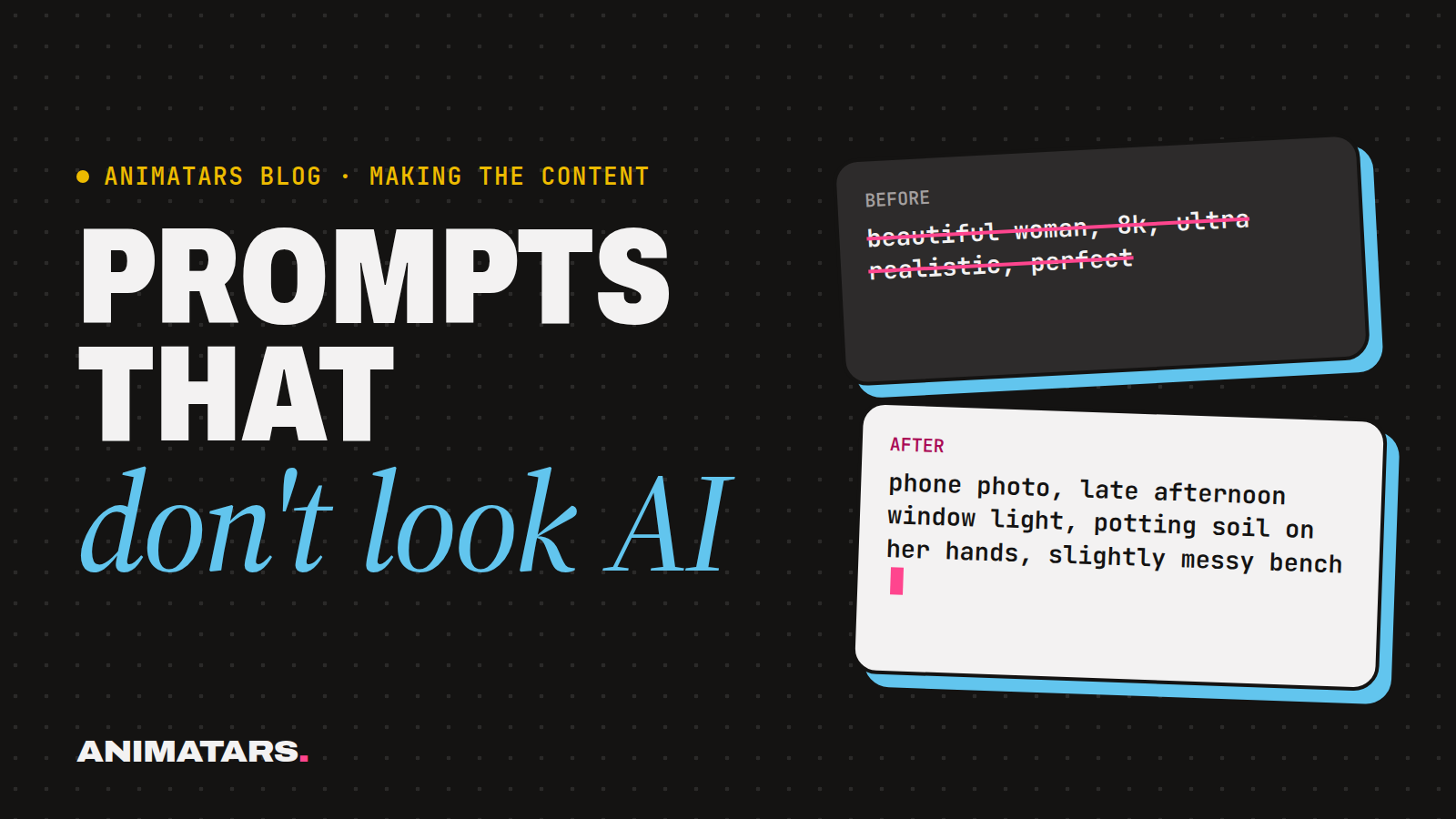
beautiful woman on a stunning boho patio, plants, cozy, 8k,
ultra realistic, masterpiece, perfect lighting
We’ve all written this prompt. And we all got the same picture back: a poreless woman glowing like a skincare ad, standing on a patio that has never seen a single dead leaf, under light that comes from everywhere and nowhere.
Nobody scrolling at 11pm thinks “how lovely.” They think “AI,” and they keep going.
This post is a teardown. We’ll take five weak AI image prompts from real niches, show what goes wrong, and rebuild each one. Then you get the rules we pulled out of them and a template you can copy. If you’re running a recurring character, pair this with our consistent AI character guide, since the prompts below only handle the scene half.
Teardown 1: The boho patio
Before: the prompt above.
What goes wrong: “Beautiful”, “stunning” and “perfect” all mean the same thing to the model: make it glossy. “8k” and “masterpiece” pile on more polish. “Plants” and “cozy” are so vague the model reaches for the most average boho patio it knows. There’s no camera, so it defaults to a studio-ish look. There’s no light source, so it lights everything evenly.
After:
Phone photo of a woman in her early thirties kneeling on a small
concrete balcony, repotting a pothos into a terracotta pot.
Jute rug with a coffee stain, two mismatched floor cushions,
a string of warm bulbs not switched on. Soil spilled on the rug.
Late afternoon sun from the left, long shadows, slight lens flare.
Eye level, slightly off-center framing, shallow depth of field.
Natural skin texture, flyaway hairs.
Why it works: every word is concrete. The spilled soil and the coffee stain tell the model this is a lived-in place. One light source, from one direction, at one time of day. “Phone photo” pulls the whole look toward something a real person would post.
Teardown 2: The $40 headboard
Before:
DIY headboard, modern bedroom, aesthetic, high qualityWhat goes wrong: no subject, no story. “Aesthetic” is a mood board in one word, so you get a generic hotel bedroom. And a DIY post with no sign of the DIY is just a furniture ad.
After:
Phone photo of a small rented bedroom, a freshly made upholstered
headboard in oatmeal linen leaning against a white wall, not yet
mounted. Staple gun and offcuts of foam on the floor, a roll of
fabric half unrolled on the bed. Rumpled duvet, one sock on the rug.
Overcast daylight through a window on the right, soft and a bit grey.
Shot from the doorway, slightly high angle.
Why it works: the leftover foam and staple gun say “someone made this today.” The overcast light is less flattering than golden hour, and that’s exactly why it reads as real. The doorway angle is how you’d actually photograph your own bedroom.
Teardown 3: The renter-friendly wall
Before:
peel and stick wallpaper living room, beautiful, realistic, 4kWhat goes wrong: “realistic” is one of those words that often makes things less realistic, because the model associates it with hyper-polished renders. Also, the most interesting part of a peel-and-stick post is the process, and this prompt shows the finished catalog shot.
After:
Close-up phone photo of a hand smoothing a strip of sage green
peel-and-stick wallpaper onto a wall with a plastic smoother.
The edge of the next strip is still curling. Backing paper crumpled
on the floor. Painted skirting board with a small scuff.
Daylight from a window behind the camera, slight shadow of the
photographer's arm. Focus on the hand and the seam.
Why it works: process shots hide the hardest AI problems (full faces, full rooms) and show the thing viewers actually want to see. Hands are risky, so keep them simple and check every finger. If the hand looks off, regenerate. Don’t post six-finger wallpaper.
Teardown 4: The weeknight dinner (cooking niche)
Before:
delicious pasta, food photography, professional, perfect platingWhat goes wrong: you’ll get a restaurant shot. If your character is a home cook, that’s off-brand, and the “perfect plating” screams staged.
After:
Overhead phone photo of a shallow bowl of spaghetti with cherry
tomatoes and torn basil on a worn wooden table. A fork twirled
into the pasta, a few strands escaping the bowl. Crumpled linen
napkin, half-empty glass of water, parmesan grated onto a small
plate with the grater still beside it. Warm kitchen light from
above, slightly yellow.
Why it works: escaping strands, the grater left out and slightly yellow kitchen light are the details that make it look like dinner, not a menu.
Teardown 5: The morning run (fitness niche)
Before:
fit athletic woman running, motivational, cinematic, epicWhat goes wrong: “cinematic” and “epic” give you a movie poster. “Fit athletic” gives you a fitness model with a body type nobody in your audience has. Motivation comes from relatability, and this prompt has none.
After:
Phone photo taken by a friend of a woman in her late twenties
jogging on a damp park path in early morning. Faded grey hoodie,
black leggings, earbuds, hair in a messy ponytail, slightly
red cheeks. Overcast sky, puddles, a dog walker blurred in the
background. Slight motion blur on her arms.
Why it works: “taken by a friend” sets a believable camera distance and angle. The puddles, red cheeks and motion blur make it a moment rather than a pose.
The rules we pulled out of the teardowns
Here’s what kept showing up across all five rebuilds.
1. Name a real camera. “Phone photo,” “taken by a friend,” “shot from the doorway.” The model behaves very differently when it imagines a person holding a phone.
2. Give the light a source and a direction. “Late afternoon sun from the left” or “overcast daylight through a window on the right.” Light from nowhere is the biggest AI giveaway there is.
3. Add mess on purpose. Spilled soil, a crumpled napkin, one sock. Real homes have clutter. Two or three specific bits of mess per scene is usually enough.
4. Delete the hype words. Stunning, beautiful, perfect, 8k, masterpiece, ultra detailed, hyperrealistic, epic, cinematic. If your tool supports negative prompts, you can also push away “glossy skin, airbrushed, plastic, oversaturated.”
5. Be specific with props. “Terracotta pot” beats “pot.” “Oatmeal linen” beats “fabric.” Specific nouns make specific pictures.
6. Ask for texture. Natural skin texture, flyaway hairs, scuffs, wood grain. Leave some imperfection in the frame.
7. Show the process. Half-finished projects look more real than finished ones, and they’re more interesting to watch.
Copy-paste template for realistic AI image prompts
[CAMERA]: Phone photo / taken by a friend / overhead phone photo
[SUBJECT]: [face lock if recurring character, otherwise who]
[ACTION]: [one clear, ordinary action]
[SETTING]: [specific room or place, size, materials]
[PROPS]: [3-5 specific items, with brands removed]
[MESS]: [2-3 small imperfections]
[LIGHT]: [source + direction + time of day + weather]
[FRAMING]: [angle, distance, focus point]
[TEXTURE]: natural skin texture, [one more texture detail]
Fill it in, then read it out loud. If it sounds like an ad, add more mess and take out an adjective.
Before you post
Run the image past three questions. Is the light coming from one believable place? Do the hands, text and reflections hold up when you zoom in? Would it look normal sitting between two real photos in someone’s feed?
Then disclose. If your creator posts realistic AI images, say so in the bio and use the AI-generated content labels that Instagram, TikTok and YouTube offer where they apply. Check each platform’s current settings. Realistic and honest go together fine.
Once you’ve got a still you love, you can bring it to life with our image-to-video AI workflow. And if you’re still choosing a generator, start with the AI creator tool stack.
FAQ
How do I make AI images look more realistic?
Describe a real camera and a real light source, add small imperfections and everyday mess, and drop hype words like stunning, 8k and masterpiece. Ask for a phone photo, not a perfect render.
What words make AI images look fake?
Stacks of quality words (ultra detailed, hyperrealistic, 8k, masterpiece, perfect), plus vague beauty words. They push the model toward glossy, airbrushed results.
What is a good AI image prompt structure?
Subject, action, setting, a few specific props, camera and framing, light source and time of day, then texture and imperfections. Keep the character’s face description fixed if you post a recurring character.
Do I need to label realistic AI images on social media?
If you’re posting realistic AI-generated images, use the platform’s AI label where it applies and say your creator is AI in the bio. Check each platform’s current settings.
Want a vault full of these?
The Prompt Vault in the Animatars Studio Pack will hold our prompts for faces, scenes, video and captions, the same kind behind DIY with Claudia and the rest of our creators. We’re in beta and building it with early members. Join the beta.