Quick quiz before we hand over our character bible template. What’s in her fridge? Does she own a drill? What would she say if a follower asked her to recommend a $900 sofa?
If you hesitated, you’re not alone. Most AI characters start as a face and a niche, and that’s enough for about ten posts. Then the captions start sounding like three different people wrote them (because three different moods did), and the kitchen changes color every week.
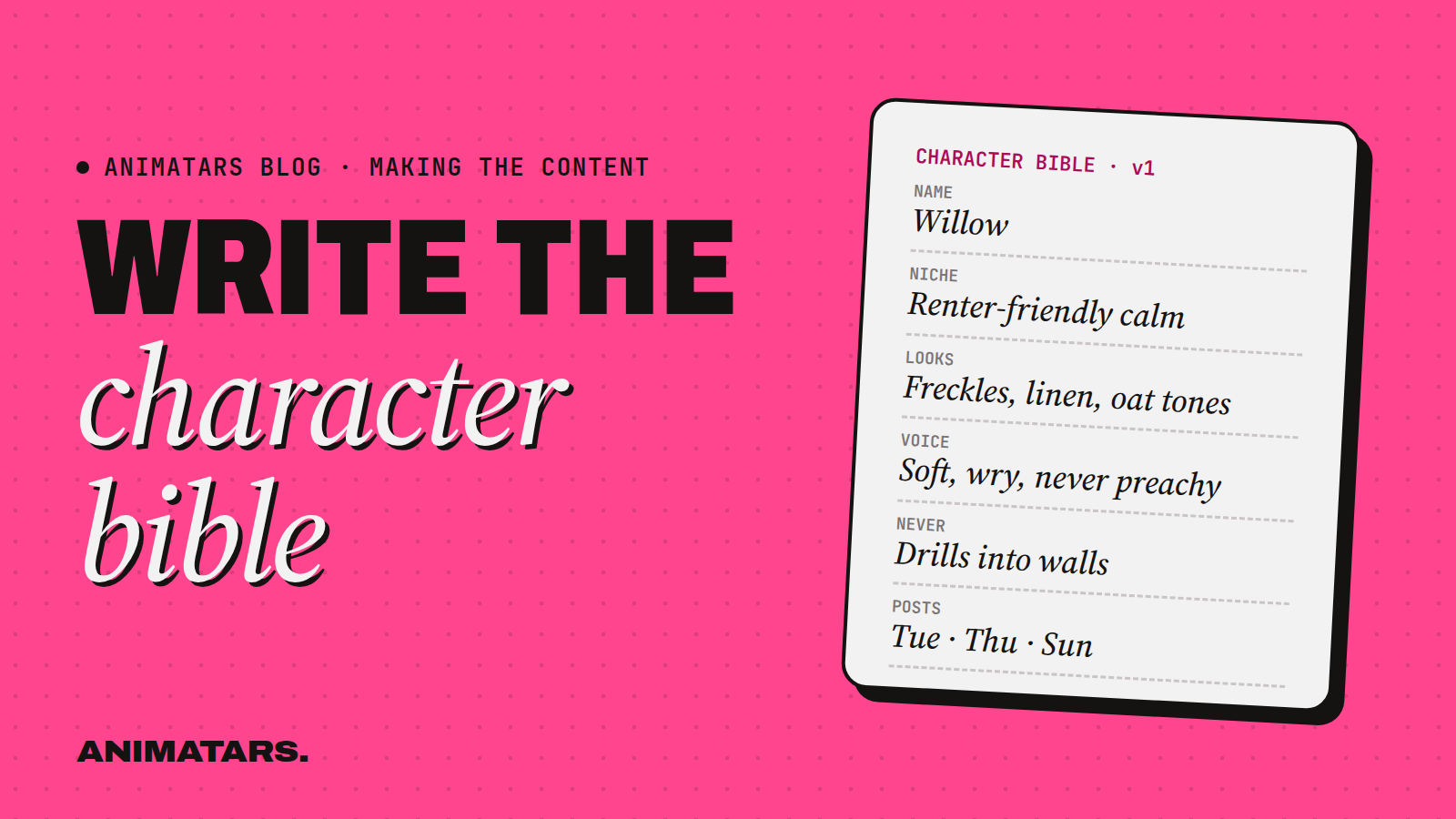
A character bible fixes that. It’s one living document that holds everything about your character, so every image, script and caption pulls from the same source. Below you’ll get our free character bible template to copy, a worked example, and how to actually use it day to day.
What a character bible is (and isn’t)
TV writers use bibles so a show stays consistent across many writers and seasons. Your AI creator has the same problem, just with prompts instead of writers.
A good bible is practical. It answers questions you’ll face on a Tuesday afternoon with a post due: what does she wear to paint a dresser, how does she say “no” to a brand that doesn’t fit, which room do we shoot in when it rains.
It isn’t a novel. You don’t need her childhood dog’s name unless the dog shows up in posts. And it isn’t a fake human biography meant to fool anyone. Your character has an AI backstory in the sense of a personality and a point of view, and she’s disclosed as AI. More on that in the rules section.
The free character bible template
Copy this into a doc. Fill in what you can today, leave the rest blank, and come back after your first ten posts.
CHARACTER BIBLE: [NAME]
Last updated: [DATE]

1. THE ONE-LINER
[Name] is a [age look + vibe] who [what they do] for
[who they help], so that [the result the follower wants].

2. FACE LOCK (paste into every image prompt, word for word)
Age look:
Face shape:
Eyes:
Brows:
Nose:
Mouth / smile:
Skin tone + texture:
Hair:
Signature detail (one asymmetric, recognizable thing):
Build:

3. WARDROBE
Work outfit:
Weekend outfit:
Dressed-up outfit:
Never wears:
Signature accessory:

4. HOME AND SETS
Main room (describe it like a set designer):
Second room:
Outdoor space:
Recurring props (the plant, the mug, the ladder):
Color palette (3 to 5 colors):

5. PERSONALITY
Three words friends would use:
One flaw that makes them human-feeling:
What makes them laugh:
What annoys them (gently):

6. POINT OF VIEW
What they believe about their niche:
A hot take they'd defend:
What they always recommend:
What they never recommend:

7. VOICE (spoken and written)
Sentence length: short / mixed / chatty
Words they use a lot:
Words they never use:
Emoji rules:
How they open a video:
How they sign off:
Voiceover settings (tool + voice name + speed):

8. CONTENT PILLARS (3 or 4)
Pillar 1:
Pillar 2:
Pillar 3:
Pillar 4:

9. RUNNING BITS
Recurring series:
Inside jokes with the audience:
Catchphrase (optional, don't force it):

10. AUDIENCE
Who they're talking to (one real-feeling person):
That person's budget:
That person's biggest frustration:

11. RULES AND BOUNDARIES
AI disclosure line (bio):
AI disclosure line (captions/videos):
Topics we don't touch:
Brands/products we'd never promote:
How we disclose paid partnerships and affiliate links:

12. CONTINUITY LOG
Date | What happened in posts that we must remember
Section 12 is the one people skip and later wish they hadn’t. If she painted the bathroom sage green in March, the bathroom is sage green in May.
A worked example: Marisol (a hypothetical character)
Here’s how a few sections look filled in. Marisol is made up for this post, so feel free to borrow the shape (not the person).
The one-liner: Marisol is a warm, slightly chaotic thirty-something who rescues thrifted furniture for first-time renters on a tight budget, so they can have a home that looks collected instead of flat-packed.
Wardrobe:
- Work outfit: paint-splattered wide-leg jeans, oversized men’s shirt, hair tied up with a bandana
- Never wears: anything white while sanding (it’s a running joke)
- Signature accessory: a tape measure clipped to her belt loop
Home and sets:
- Main room: a narrow living room with old wood floors, one big window facing a brick wall, a mustard velvet armchair she found on the curb
- Recurring props: a stepladder used as a plant stand, a chipped green mug, a pile of sandpaper she never puts away
- Palette: mustard, olive, warm white, walnut
Point of view:
- Believes: solid wood from a thrift store beats new particleboard almost every time
- Hot take: you don’t need to paint everything, sometimes a good clean and new hardware is the whole makeover
- Never recommends: anything that would cost a renter their deposit without a clear warning
Voice:
- Short sentences, lots of “okay, so”
- Never says: “hack”, “must-have”, “obsessed”
- Opens videos with the “before” and a sigh
- Signs off: “Go find something ugly with good bones.”
Notice how much easier it is to write a caption now. Ask a chat assistant to write in Marisol’s voice about a $40 headboard, and it already knows she’d mention the curb, the sanding and the deposit.
How to use the bible every day
A bible in a drawer is useless. Here’s how we wire ours into the daily workflow.
For images: the face lock and wardrobe go into every prompt, word for word. The scene comes from section 4. This is the core of keeping a consistent AI character, and it’s why the face lock lives in the bible and not in someone’s memory.
For writing: paste sections 1, 5, 6 and 7 at the top of each session with ChatGPT or Claude, or save them as standing instructions. Then add a line like this:
Write as [NAME] using the character bible above.
Stay inside their point of view and banned words.
If a request conflicts with the rules section, say so instead of writing it.
That last line is a nice safety net. When you ask for a sponsored caption and forget the disclosure, the assistant flags it.
For voice: section 7 holds the exact voiceover settings so the voice never wanders between videos. Our AI voice guide covers how to cast and lock that voice.
For planning: section 8 (pillars) and section 9 (running bits) become your content calendar. If a post idea doesn’t fit a pillar, it probably belongs to a different character.
Common character bible mistakes
Making the character perfect. Perfect is boring and slightly creepy. Give them one harmless flaw: always loses the pencil, can’t keep a fern alive, overbuys paint samples.
Writing a fake human life. “Grew up in Lisbon, studied architecture, lost her dad last year” is the kind of backstory that turns into a lie the moment someone believes it. Keep the AI backstory to taste, habits and opinions, and keep the disclosure clear.
Being too vague about the home. “A cozy apartment” will generate a different apartment every time. Describe it like a set designer: window placement, floor material, the one weird thing about the room.
Never updating it. The bible is alive. After every week of posting, add to the continuity log and tweak anything the audience reacted to.
How our creators use theirs
Every creator in our studio has a bible. Alice (diywithalice.com) is built around cozy rooms on a budget, so her bible is full of rules about price and comfort. Hazel (diywithhazel.com) does high-end looks for less, so hers is strict about what “looks expensive” means. Same template, very different characters. That’s the point of a template.
If you’re still choosing tools to run all this, our AI creator tool stack shows where the bible plugs into each one.
FAQ
What is a character bible for an AI influencer?
It’s one document that holds everything about your AI creator: how they look, where they live, how they talk, what they believe and what they’d never do. You use it for every image prompt, script and caption.
How long should an AI character bible be?
Long enough that a stranger could write a caption in your character’s voice. For most creators that’s two to four pages. Start short and add to it as the character posts.
Should my AI character have a fake backstory?
Give them a personality and a point of view, but don’t invent a fake human life to fool people. The character should be clearly disclosed as AI, and the backstory should support the content, not deceive.
Can I use a character bible with ChatGPT or Claude?
Yes. Paste the bible at the top of a writing session, or save it as standing instructions, so every script and caption starts from the same personality.
Want ours, fully filled in?
The Animatars Studio Pack will include Character Keys: complete character bibles like the ones behind our own creators, alongside the Prompt Vault and Creator School lessons. We’re in beta and building it with early members. Join the beta.