“So who’s actually posting?” It’s a fair question. You scroll past a woman repotting a monstera on a sunny patio, she has opinions about terracotta, and then the bio says she’s AI-generated. Your brain does a little double take.
So, what is an AI influencer? Short version: a character made with AI tools, run by people, posting for an audience on purpose. This guide gives you the long version. You’ll get a plain definition, the parts that make one work, the myths we hear every week, and a 20-minute exercise you can do tonight to sketch your own.
We build these for a living, so expect opinions.
What is an AI influencer, in plain words?
An AI influencer (you’ll also hear virtual influencer or AI creator) is a social media personality whose face, photos, videos and often voice come from AI tools instead of a camera pointed at a human. The character has a name, a look that stays the same from post to post, a point of view and a topic it keeps coming back to.
The part people miss: there is always a human team behind it. Somebody picks the niche. Somebody writes the captions, or at least edits them hard. Somebody decides that the character would never recommend a cheap rug that sheds everywhere. The AI makes the pictures. People make the choices.
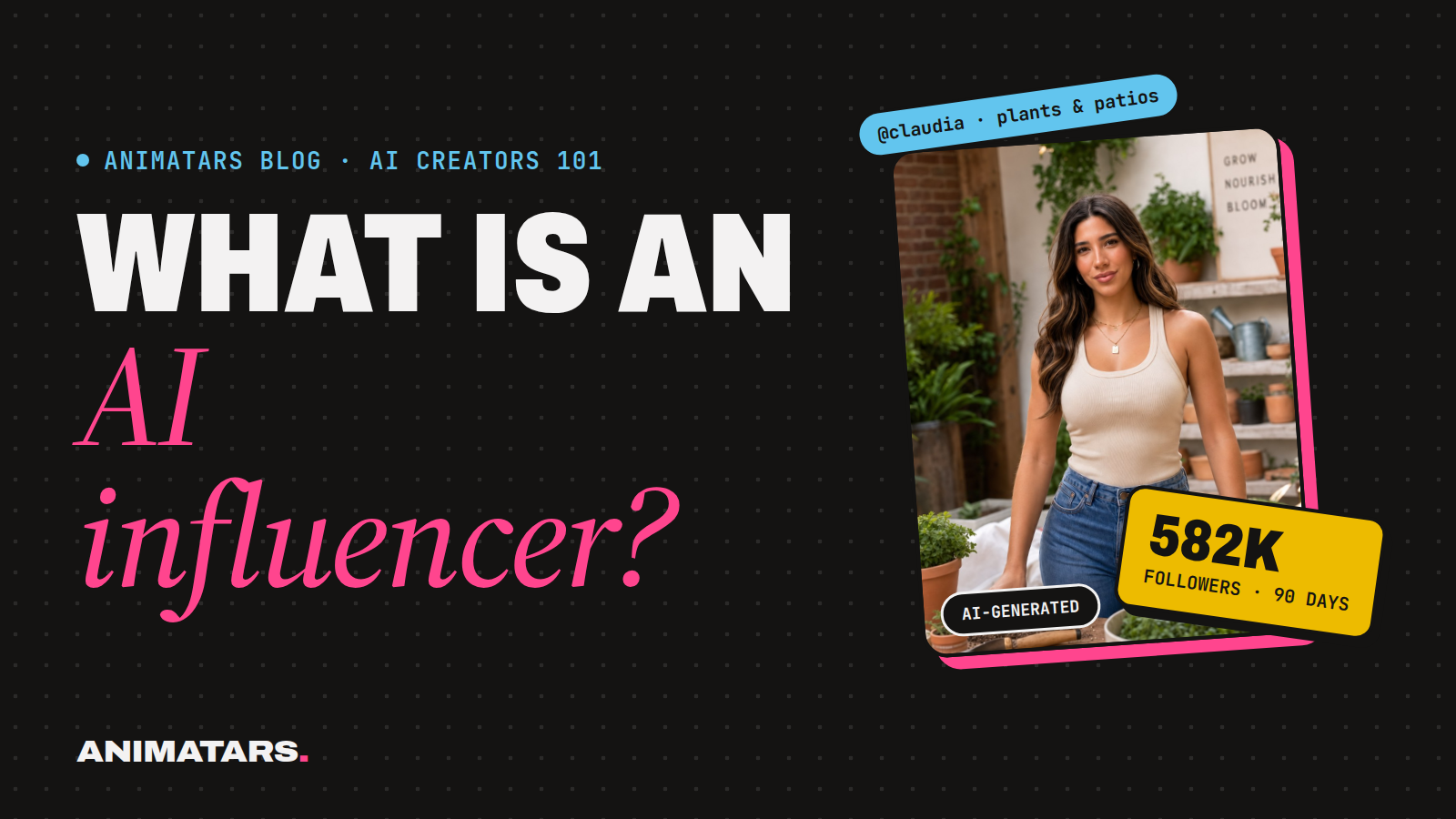
Here’s a real example from our studio. Claudia is our DIY creator: plants, patios, boho makeovers. She’s fully AI-generated and says so. In her first 90 days she reached 582K+ followers and 100M+ views across platforms, with zero real faces shown. That isn’t a promise for anyone else (results vary, a lot), but it does answer the question “can this even work?”
The difference between an AI influencer and an AI filter
A filter changes a real person’s face. An AI creator doesn’t have a real face to change. There’s no one in the photo who went to the garden center that morning. That’s why disclosure matters so much, and we’ll come back to it.
The five parts every AI creator needs
When an AI creator works, it’s because five boring-sounding pieces are in place. When one flops, one of these is usually missing.
1. A character, not a face. A pretty face gets a glance. A character gets a follow. Claudia has a backstory, favorite colors, a thrifting habit and a mild feud with fake plants. That’s what makes her captions sound like a person rather than a product listing. We keep all of this in what we call a character bible.
2. A face that stays the same. If her jawline changes every Tuesday, people notice, even if they can’t say what’s off. Consistency across angles, rooms and lighting is the single hardest technical skill here. Tools like Midjourney or Flux can get you there, but it takes reference images and patience.
3. A useful niche. “Lifestyle” is not a niche. “Renter-friendly calm for small apartments” is a niche (that’s Willow). “High-end looks for less” is a niche (that’s Hazel). The tighter the topic, the easier it is for someone to decide in two seconds whether you’re for them.
4. A voice. Literally and figuratively. Some creators speak in video using a synthetic voice from something like ElevenLabs. All of them need a written voice: how they open captions, which words they’d never use, whether they’re bubbly or dry.
5. A plan for where the audience lives. Followers on a platform are rented. The long game is moving people onto something you control, like a website and an email list. More on that below.
Myths vs reality
Let’s clear out the stuff we hear most.
Myth: “It’s just pressing a button.”
Reality: making one good image is quick. Making 200 images of the same person, in different rooms, holding a drill the right way, with hands that have five fingers, is a craft. Then add video, captions, comments and a posting rhythm. It’s a creative job with very good power tools.
Myth: “AI influencers have to pretend to be human.”
Reality: the ones we’d want to follow don’t. Instagram, Facebook, TikTok and YouTube all have ways to label AI-generated or realistic synthetic content, and we use them. Claudia’s audience knows she’s AI. They follow her anyway because the patio ideas are good. (Settings change, so check each platform’s current options when you set up.)
Myth: “Nobody cares about a fake person.”
Reality: people care about useful, entertaining things. A $40 headboard makeover is useful whether the hands holding the staple gun are real or rendered. What people don’t forgive is being fooled. Disclose, then be helpful.
Myth: “You need a big budget.”
Reality: you need time and taste more than money. The bigger cost is the hours spent getting a consistent character and learning what your audience actually saves and shares.
Myth: “It’ll make money right away.”
Reality: some AI creators earn through brand deals, affiliate links and digital products. Many don’t, or not for a while. We won’t promise income, and you should be wary of anyone who does.
Myth: “Once it’s set up, it runs itself.”
Reality: the AI doesn’t know your audience. You do, eventually, by reading comments and noticing which posts get saved. An AI creator with nobody steering turns into a feed of pretty, forgettable pictures.
Where AI influencers shine (and where they struggle)
From what we’ve seen building our own creators, they’re strongest when the content is visual and teachable:
- Home decor and DIY. Before-and-after rooms, styling a bookshelf, a peel-and-stick wall in a rental. This is our home turf, with Claudia, Alice, Hazel, Willow and Logan.
- Gardening and plants. Repotting, patio setups, “what to grow on a north-facing balcony.”
- Recipes and food styling, as long as the recipes are tested by an actual human.
- Explainers and storytelling, where the character is a host.
They struggle where personal lived experience is the whole product. A character can’t honestly say “this skincare cleared my face” or “I lost weight on this plan.” It doesn’t have a face or a body. We cover where those lines are in Are AI Influencers Ethical?, and we do a fuller head-to-head in AI Influencer vs Human Influencer.
Try this tonight: the 20-minute character sketch
Grab a notes app and answer these. Don’t overthink it. You can change everything later.
- Name: Something easy to say out loud and search. First name only is fine.
- One-line promise: “I help [who] do [what] without [pain].” Example: “I help renters make tiny bedrooms feel calm without losing the deposit.”
- Look: Age range, hair, style of clothes, one signature detail (a bandana, a canvas apron, gold hoops).
- Home base: Where do they “live” in the content? A sunny patio? A tiny city studio? A garage workshop?
- Three things they love: Be specific. “Thrifted brass” beats “vintage.”
- Two things they’d never do: “Never recommends something she wouldn’t use.” “Never says ‘hack.’”
- Five first post ideas: Each one should be something a stranger could save. “3 ways to hide an ugly radiator” is saveable. “Happy Monday!” is not.
- Disclosure line: Write the line for the bio now, like “AI-generated creator. Real tips.” Decide it before you post, not after someone asks.
If you finish and still like the character, you’re ready for the next step. Our weekend plan for creating an AI influencer takes this sketch and turns it into a face, a first batch of posts and live accounts. If you’re stuck at question 2, the AI influencer niche ideas post has 27 starting points and a quick test to pick one.
What the full journey looks like
Here’s the path we follow at Animatars, and the one we’re building tools around:
Design the character. Bible, face, voice, look.
Launch the accounts. Profiles, bios with disclosure, the first few weeks of posts.
Grow the audience. Consistent posting, learning from comments, testing hooks and formats.
Own it. Put the character on its own site with an email list and a store, so you aren’t relying on one algorithm’s mood. You can see how that looks for Claudia at diywithclaudia.com.
That last step is the one most people skip, and the one we care about most. Member sites, newsletters and stores are what we’re building for Animatars members. The Studio Pack will include the Creator School video lessons, the Prompt Vault, Character Keys (full character bibles), tutorials, site templates, email and store hookups, and an affiliate link.
FAQ
What is an AI influencer, exactly?
An AI influencer is a social media character whose face, images, video and often voice are made with AI tools, run by real people who decide what it posts, says and recommends.
Are AI influencers real people?
No. The character is generated, but there are always humans behind it making the creative decisions. Good AI creators say clearly that they’re AI-generated, in the bio and with each platform’s labels.
Can an AI influencer actually grow an audience?
It can. Claudia reached 582K+ followers and 100M+ views across platforms in 90 days without showing a real face. Results vary a lot, and nothing about growth is guaranteed.
Do I need to be technical to make an AI influencer?
No. You need taste, patience and a clear niche more than coding skills. The tools are point-and-type. The hard part is keeping a character consistent and genuinely useful.
Your move
If the character sketch got you a little excited, that’s the sign. We’re opening Animatars to a small group of creators while we build. Join the beta and build your first AI creator with us.