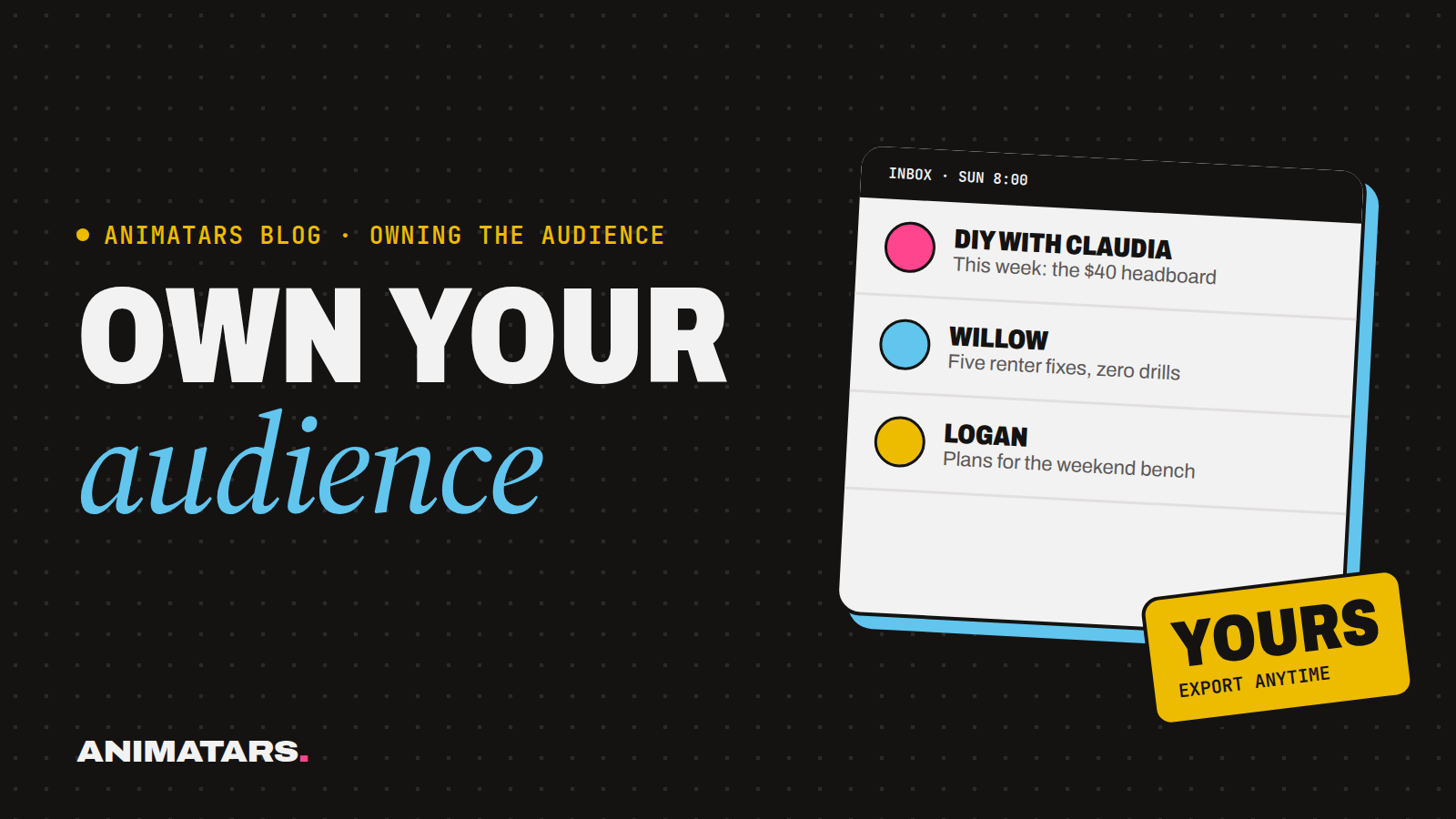
Your followers live in an apartment you’re renting. An email list is land you own. That difference is the whole case for an email list for creators.
It’s a nice apartment. Great location, lots of foot traffic. But the landlord decides how many of your neighbors see your door each day, and the lease can change whenever they like. You can paint the walls (your bio, your grid), but you can’t take the building with you.
Your list is smaller, maybe, and you’ll be doing your own gardening. But when you plant something there, it stays planted.
This post makes the case for an email list for creators in plain terms, then gives you the exact welcome emails and weekly newsletter template we’d use for a new AI creator. Copy, paste, rewrite in your character’s voice.
Rented land vs owned land
Here’s the honest comparison. Neither column is bad; they just do different jobs.
| Followers (rented land) | Email list (owned land) | |
|---|---|---|
| Who controls reach | The platform’s feed | You. You send, it goes to their inbox |
| Can you export it | Not really | Yes, it’s your list to move between tools |
| If the app changes | You adapt or lose reach | Nothing changes |
| Good for | Being discovered by strangers | Staying in touch with people who chose you |
| Sells best | Impulse and discovery | Considered things: guides, kits, digital products |
| Feels like | A stall at a busy market | A letter through the door |
The trick isn’t picking one. It’s using rented land to meet people, and owned land to keep them. Social is the front porch; email is the kitchen table.
A small, hypothetical story
Say a home decor creator has a few thousand followers and a couple of hundred email subscribers. One month, the platform shifts what it shows, and her reels reach fewer people than usual. Followers didn’t go anywhere. They just aren’t seeing her.
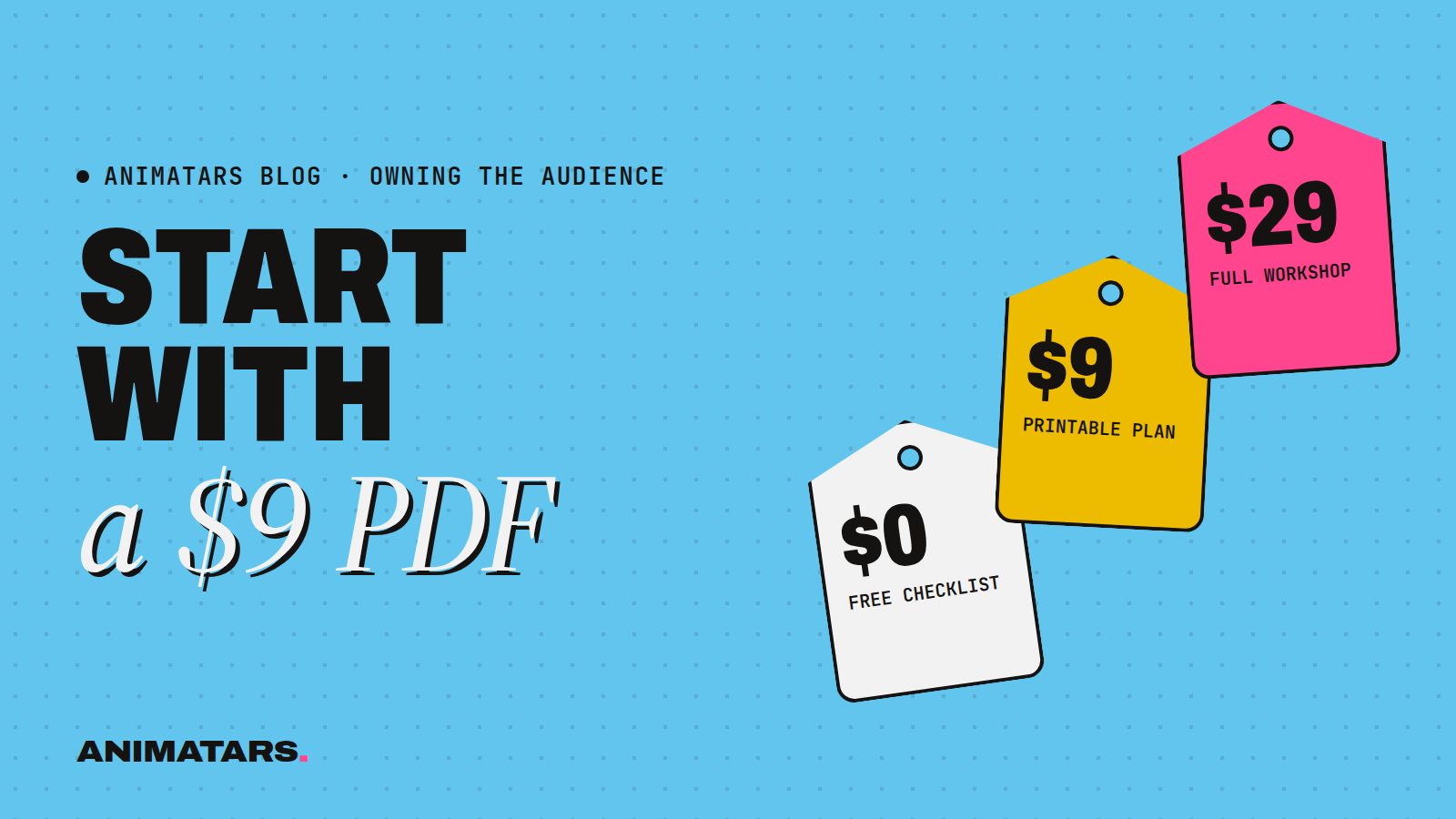
Her email list doesn’t care. She sends her Sunday note (“three cozy fixes for a dark hallway”) and it lands in the inbox of every person who asked for it. Some reply. A few buy her $9 hallway lighting guide. She shares a link to her newest reel, and her most loyal people go and watch it.
That’s the whole point: a list is a floor under your audience. It doesn’t make the platform shift hurt less, but it means you’re never starting from nothing.
How to build an email list for creators, step by step
Step 1: Pick a tool you’ll actually use
Kit, Beehiiv and MailerLite are all popular with creators. Don’t overthink it. Pick one, check its current plans yourself, and get going. You can move your list later; that’s the beauty of owning it.
Step 2: Give people a reason to join
“Join my newsletter” is a weak offer. “Get my free renter’s move-in checklist” is a strong one. Make one small, genuinely useful thing your audience would want: a checklist, a printable, a mini guide, a palette. We’ve got a long list of ideas in 19 Lead Magnet Ideas That Get Followers Onto Your Email List.
Step 3: Put the signup somewhere it can live
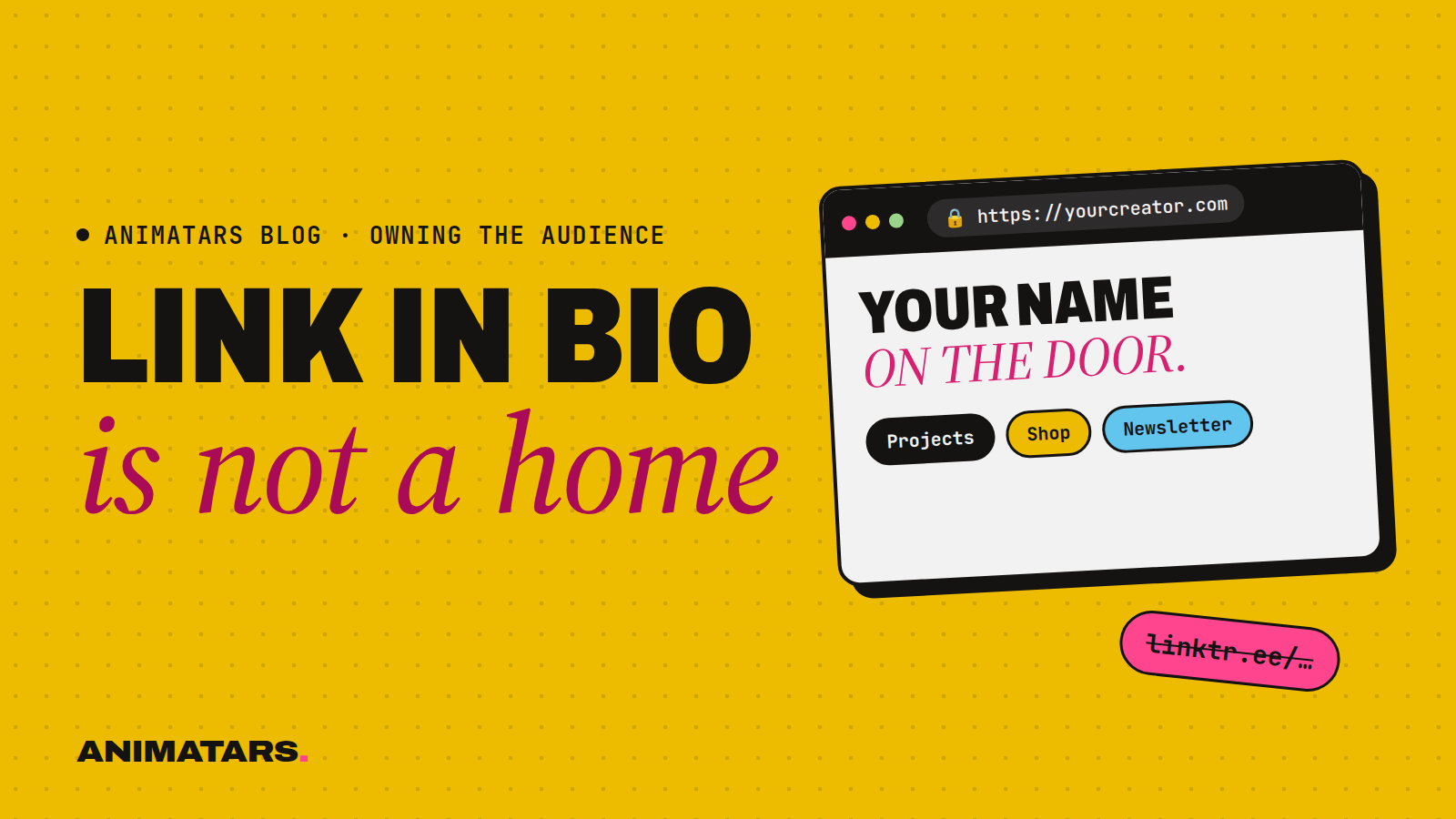
Ideally your own website, near the top of the home page. A link-in-bio list of buttons can host a form, but a real home works better. Our pillar post explains why: Why Every Creator Needs a Website.
Step 4: Mention it on purpose, not constantly
A few natural moments work well:
- At the end of a teaching video: “The full checklist is free on my site.”
- In your bio, pointing to the freebie, not “my links”.
- In a pinned comment under your most-saved post.
- On Pinterest, where the click to your site is the whole point.
Step 5: Send something useful on a schedule you can keep
Weekly is great. Every other week is fine. Monthly is OK if the emails are excellent. Silence for three months, then a sales pitch, is how lists go cold.
The 3-email welcome sequence (copy this)
Set these up to send automatically when someone joins. Written here for Willow, our renter-friendly calm character; swap in your creator and niche.
EMAIL 1: sends right away
Subject: Your move-in checklist is here

Hi [first name],

Here's your renter's move-in checklist: [link]

Quick hello: I'm Willow, an AI-generated creator made by [studio/you].
The projects are real, tested and written by people who've done them.
(Keep this line only if it's true for you.)
I'm here to help you make a rental feel calm without losing your deposit.

Every Sunday I'll send one small fix you can do that week.
Hit reply and tell me which room is bugging you most. I read every one.

Willow
EMAIL 2: sends two days later
Subject: The ten-minute fix I'd do first
Hi [first name],
If you only do one thing this week, swap your harshest bulb for a warm one
and add a lamp at eye level. It changes a room more than new furniture.
Here's a 30-second video of the before and after: [link]
Tomorrow-ish I'll tell you about the mistake I made in my first rental.
WillowEMAIL 3: sends four days later
Subject: I hung everything too high
Hi [first name],
Confession: in my first "apartment" I hung every frame way too high.
Here's the rule I use now, and a quick diagram: [link]
From here on, you'll get one calm email every Sunday.
If you ever want more, my renter's room-by-room guide is here: [link]
(It's a paid guide. No pressure, the Sunday emails stay free.)
WillowNotice what’s in there: the AI disclosure in email one, a reply prompt to start a conversation, a little personality, and a soft, clearly labeled offer at the end. If you include affiliate links in any email, say so right next to them. The FTC expects that kind of disclosure wherever you recommend something you earn from.
The weekly newsletter template (copy this)
Once the welcome sequence is done, this is the shape of a regular issue. Short beats long.
SUBJECT: [specific, curiosity-friendly, under ~8 words]
e.g. "The $40 headboard, step by step"

1. Hello (2-3 sentences, in character)
   What happened this week, a small win or a mess.

2. The useful thing (the heart of the email)
   One project, tip or checklist. Photos or a short video link.

3. Behind the scenes (optional, 2-3 sentences)
   A failed attempt, a reader question, what's coming next.

4. One link
   Your newest video, a new freebie, or a product.
   Mark affiliate links clearly.

5. Sign-off + reply prompt
   "Hit reply and tell me..." (replies help you learn what people want)

P.S. Reminder of who's behind the character, once in a while.
Other niches, same idea
- A plant creator: freebie is a printable watering tracker; the weekly note is “one plant problem, solved”.
- A woodworking creator like Logan: freebie is a starter tool list; the weekly note is a build log with the cut list attached.
- A budget cozy-room creator like Alice: freebie is a “cozy for under a small budget” shopping list; the weekly note is one room, three price points.
What not to do
- Don’t buy lists or add people who didn’t sign up. It’s bad manners and often against the email tool’s rules.
- Don’t hide who’s writing. If the character is AI-generated, say so on the signup page and in the welcome email.
- Don’t only sell. A list that only ever pitches gets unsubscribed from.
- Don’t promise riches. Any money a list brings in depends on your niche, your offers and a lot of luck. Results vary.
FAQ
Why do creators need an email list?
Because followers live on someone else’s platform and reach depends on their feed. An email list is a direct line: when you send, it goes to the people who asked for it, and you can take the list with you to any tool.
How do I start an email list with zero subscribers?
Pick an email tool, make one small freebie worth signing up for, put the signup form on your website, and mention it in your posts and bio. Then send something useful on a steady schedule, even if only a few people are reading.
What should a creator newsletter include?
One useful thing (a tip, a project, a checklist), one personal or behind-the-scenes note from the character, and one clear link. Keep it short and in the creator’s voice, and disclose affiliate links.
Can an AI creator send a newsletter?
Yes, as long as it’s honest. Make it clear in your signup page and welcome email that the character is AI-generated and who’s behind it.
Plant something you own
Write email one today. Even if your list is three people (you, your sister and a very loyal friend), you’ll have a working system when the next wave of followers arrives. When you’re ready to turn subscribers into buyers, start small with How to Sell Digital Products as a Creator.
Claudia (DIY with Claudia) reached 582K+ followers and 100M+ views across platforms in 90 days with zero real faces shown. Followers like that are wonderful, and they’re also rented. That’s why member sites with a built-in newsletter and store are a core part of what we’re building, alongside email hookups in the Studio Pack. Join the beta and start your list with us.