Are AI influencers ethical? Here’s our opinion, up front, so you don’t have to hunt for it: AI influencers aren’t ethical or unethical by default. It depends almost entirely on whether the people running them are honest.
That sounds like a dodge. It isn’t. A camera doesn’t make a human creator ethical either. Plenty of real people post misleading ads, fake before-and-afters and reviews of products they never opened. The tool changes what’s possible. The choices are still yours.
So in this piece we’ll take the real worries seriously, say where we think the lines are, and then show you the house rules we follow at our studio. Copy them. Change them. Pin them above your desk. Just have some.
Are AI influencers ethical? The worries worth taking seriously
We hear the same handful of concerns whenever we talk about what we do. Some are fair. Some are fair with an asterisk.
“It’s deceiving people.”
This is the big one, and it’s fair. If someone follows a character believing she’s a real woman who really did repaint her kitchen, and she isn’t, that’s a deception. Small, maybe, but real.
Our take: the fix is simple and non-negotiable. Say it’s AI. In the bio, in the platform labels, and in the comments when someone asks. Once people know, they’re choosing to follow a character, the same way they’d follow a cartoon mascot or a novel’s narrator. Nobody feels tricked by a cartoon.
“It sets impossible beauty standards.”
Also fair. AI tools drift toward flawless skin, perfect symmetry and bodies that don’t exist. A feed of that, presented as real, can make people feel worse about their own faces.
Our take: disclosure helps, because “this person isn’t real” changes how you read the image. But we also make deliberate choices. Our creators have texture, a bit of messiness, normal-looking hands holding normal-looking tools. The point of a DIY creator is the project, not the cheekbones.
“It takes work away from real creators.”
This one’s complicated. AI creators do compete for attention, and some brand budgets.
Our take: every AI creator we’ve built has humans behind it doing real creative work: writing, art direction, editing, community management, product research. It’s a different way to be a creator, often for people who’d never show their face online for reasons of privacy, safety or plain shyness. We’d rather widen the door than pretend it isn’t there.
“It can fake reviews and endorsements.”
Completely fair, and this is where things go genuinely wrong. A character can’t try a serum, can’t feel whether a mattress is comfy, can’t tell you a supplement worked.
Our take: this is the brightest line we have. More on it in the rules below.
“What about using real people’s likeness?”
Fair, and simple. Don’t build a character that looks like a real person, and don’t use someone’s face or voice without permission. Ever.
Our house rules
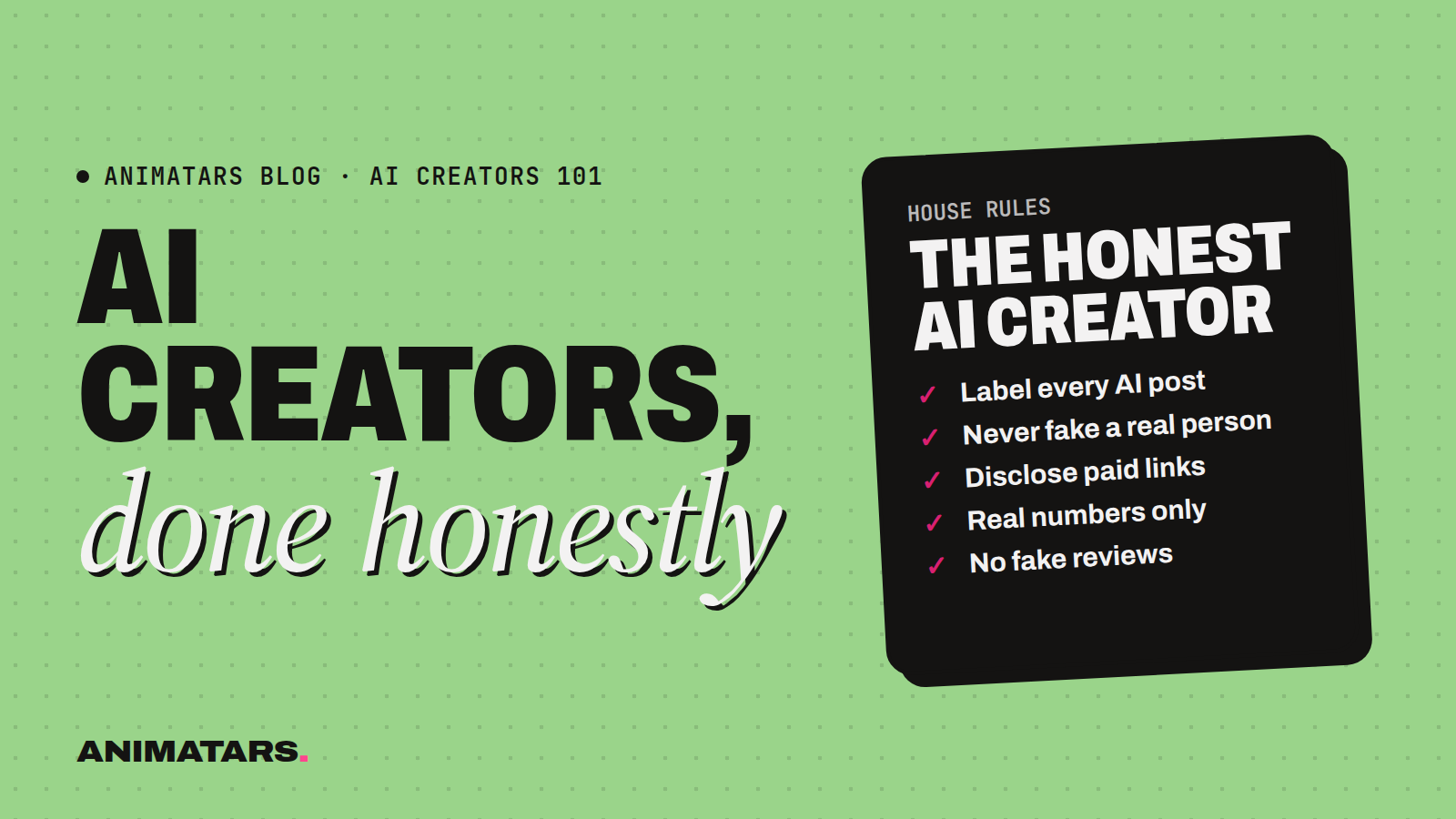
These are the rules we follow for every creator at Animatars, including Claudia, Alice, Hazel, Willow and Logan. They’re not legal advice; they’re how we try to be decent.
Rule 1: Disclose, everywhere, always
Every bio says the creator is AI-generated. We turn on the AI-content labels that Instagram, Facebook, TikTok and YouTube offer for AI-generated or realistic synthetic content wherever they apply. Platforms update these settings, so we check them regularly rather than setting and forgetting.
Rule 2: Answer honestly when asked
If a commenter asks “is she real?”, the answer is a cheerful, clear no. Never a coy wink, never “what do you think?”
Rule 3: No body-based claims
Our creators don’t say a product changed their skin, hair, weight or health. They don’t have those things. If a human on the team tested something, we say so in plain words: “Our team tried this primer on a bathroom cabinet. Here’s what happened.”
Rule 4: Only recommend what a human checked
Before a character recommends a paint, a planter or a staple gun, someone on the team has looked into it properly. If we wouldn’t tell a friend to buy it, the character doesn’t either.
Rule 5: Label every paid post and affiliate link
The FTC expects paid partnerships and affiliate links to be disclosed, and that applies to AI creators the same as anyone. We label them in words people will see, not buried under a “more” button, and use the platform’s paid partnership tools.
Rule 6: No real faces, no real people’s likeness
Our characters don’t resemble real people, and we never clone a real voice without consent. Claudia reached 582K+ followers and 100M+ views across platforms in 90 days with zero real faces shown. You don’t need anyone’s likeness to build an audience.
Rule 7: Keep kids out of it
We don’t build characters aimed at children, and we don’t generate realistic images of children for content. A kids’ room makeover shows the room, not a child in it.
Rule 8: Don’t fake the work
If a project couldn’t really be done the way it’s shown (a “one-hour” built-in wardrobe, say), we don’t pretend it can. Our DIY steps should work for a real person with real tools. Logan’s builds should be buildable.
Rule 9: Don’t promise money
When we talk about earning as a creator, we say plainly that results vary and income isn’t guaranteed. Nobody should start an AI creator because someone promised them a payday.
Rule 10: Build trust you can take with you
We want audiences on sites and email lists that creators own, not only on platforms. That’s part of why member sites, newsletters and stores are what we’re building at Animatars. It’s also more honest: people who join an email list are choosing to hear from you, with eyes open.
A quick ethics check before you post
Run each post through these five questions. If any answer is “no,” fix it before it goes up.
- Would someone who just landed here know this is an AI creator?
- Is every claim in the caption something the character, or a named human on the team, can honestly stand behind?
- Is every paid post and affiliate link labeled clearly?
- Would I be comfortable if a journalist screenshotted this and asked me about it?
- Does this help the viewer do or understand something?
That fifth one isn’t strictly ethics. But we’ve noticed that the posts that are genuinely helpful almost never need ethical gymnastics to defend.
Where we land
Being honest is what makes an AI creator work long term, and also the right thing to do. A disclosed character with good ideas earns trust the same way anyone does: by being useful, again and again. A hidden one is always one comment away from collapse.
If you’re weighing whether to build a character or show up as yourself, the round-by-round comparison in AI Influencer vs Human Influencer might help. If you’re new to all of this, start with the pillar guide, What Is an AI Influencer?, and check the AI influencer mistakes we’ve made ourselves, several of which are about exactly this.
FAQ
Are AI influencers ethical?
They can be. An AI influencer is ethical when it clearly discloses that it’s AI, doesn’t claim experiences it can’t have, labels paid posts and affiliate links, and only recommends things real people on the team have checked.
Do AI influencers have to disclose they are AI?
We think they always should. Instagram, Facebook, TikTok and YouTube all have ways to label AI-generated or realistic synthetic content. Check each platform’s current settings, since rules and menus change.
Is it wrong to make money with an AI influencer?
No, as long as the audience knows what they’re following and paid partnerships and affiliate links are disclosed, as the FTC expects of any creator.
Can an AI influencer review products?
It can present, style and compare products, and share findings from a human who actually tested them. It shouldn’t claim personal results, like a cream clearing its skin.
Build it the honest way
If these rules sound like how you’d want to work, you’ll fit right in. We’re building Animatars with transparency baked in, from Character Keys to the site templates. See Claudia’s world at diywithclaudia.com, then join the beta.