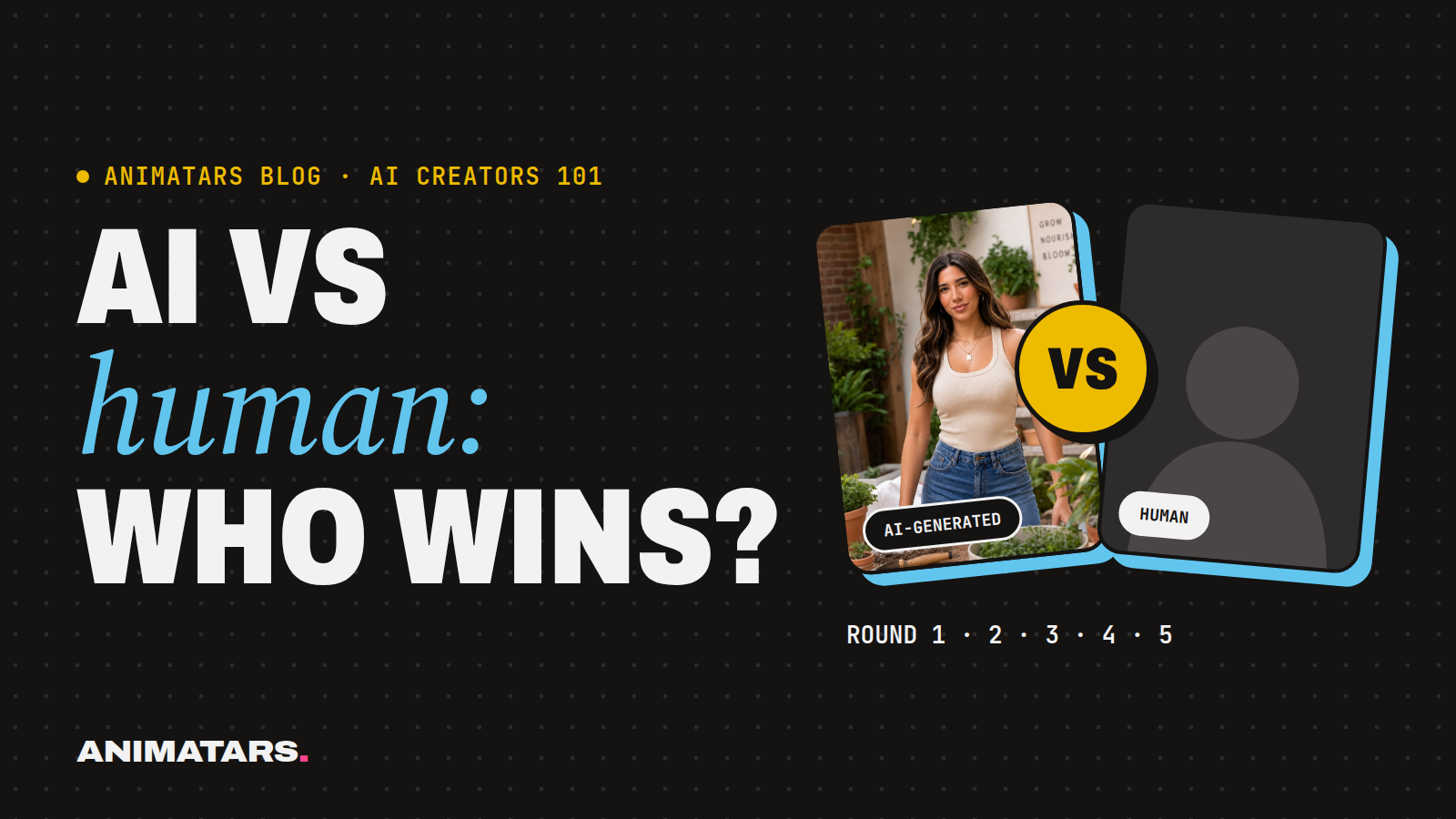
Ladies and gentlemen, in the red corner: a person with a ring light, a real living room and opinions about grout. In the blue corner: an AI-generated creator who never gets a cold, never has a bad hair day and has to tell everyone she isn’t real.
The question of AI influencer vs human influencer gets argued like it’s a cage fight. Honestly, it’s more like a boxing match with a lot of rounds, and each fighter is great at different ones. So that’s how we’re going to score it. Eight rounds, a scorecard at the end, and a verdict you can actually use when deciding what to build.
Full disclosure: we’re biased. We build AI creators for a living. We’ll try to call it straight anyway, and we’ll give human creators the rounds they win, because they win some big ones.
Round 1: Showing up
Human: Has to be camera-ready. Has to be in the room. Has to film the same shot four times because the dog walked through it. Vacations mean pre-batching or going quiet.
AI: Can be “on location” on a sunny patio at 11pm on a Tuesday. No commute, no makeup, no lighting fight with the sun. The work is still real (prompting, editing, rejecting a lot of images), but it fits around a life.
Round to: AI. Not by a knockout. Making good AI content still takes hours. But the physical “be there and look ready” tax is gone.
Round 2: Consistency
Human: Your face is your face. Consistency is free. The struggle is consistent output: posting when you’re tired, sick or busy.
AI: Output can be steady because you can batch ahead. Face consistency, though, is the hardest technical skill in the whole game. Keeping one AI character looking like the same person across rooms, angles and outfits takes reference images, careful prompts and a lot of rejects.
Round to: a draw. Humans get the face for free; AI gets the schedule for free. Each one has to fight for the other.
Round 3: Lived experience
Human: Did the thing. Sanded the dresser. Got the splinter. Knows the paint really did take three coats, not the two on the can.
AI: Didn’t do the thing. The team behind it may have, and that knowledge can go into the content. But the character itself can’t honestly claim a personal result, especially for anything involving a body: skincare, fitness, health, weight.
Round to: Human, clearly. This is the biggest round on the card. If your content is “I tried this and here’s what happened to me,” a human wins. AI creators should stick to teaching, showing and styling, which is a lot of territory, but not all of it.
Round 4: Trust
Human: Starts with a head start, because people assume there’s a real person. Can lose it fast with an undisclosed ad or a fake-looking review.
AI: Starts behind. The very first question is “is this real?” The answer has to be yes-it’s-AI, right in the bio, plus each platform’s AI label where it applies. Instagram, Facebook, TikTok and YouTube all have ways to mark AI-generated or realistic synthetic content, and you should check their current settings when you post.
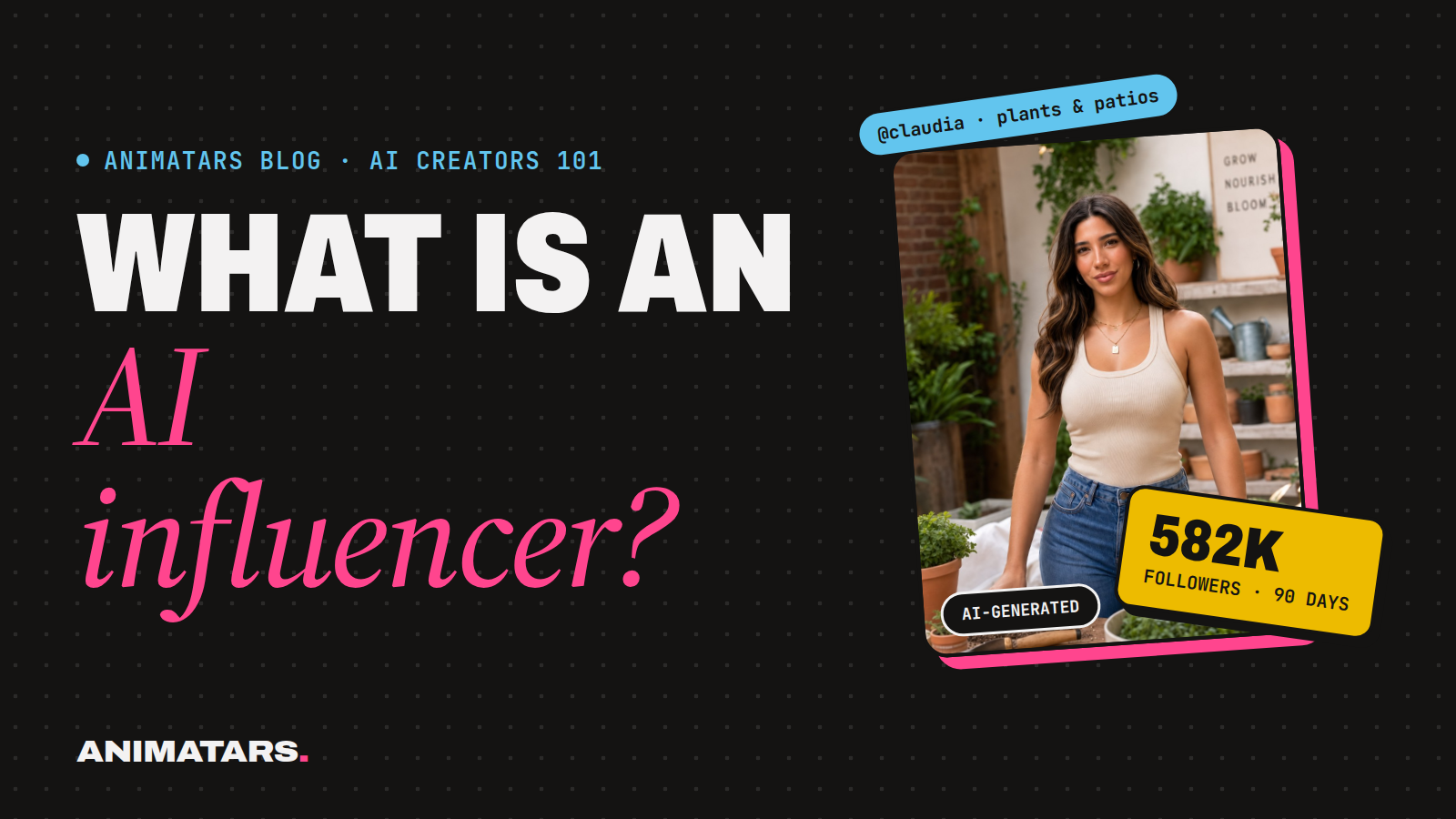
Here’s the thing we’ve learned, though: once an AI creator is upfront, trust gets built the same way as for anyone. Be useful. Be consistent. Don’t hype junk. Claudia is fully AI-generated and disclosed, and she reached 582K+ followers and 100M+ views across platforms in 90 days. Her audience follows for patios and plant swaps, and they know exactly what she is.
Round to: Human, on points. The AI creator can close the gap, but it starts the round down.
Round 5: Privacy and safety
Human: Your face, your home, your kids’ voices in the background, your neighborhood visible through the window. Some creators love that. Many find it exhausting, and a few find it scary.
AI: The face isn’t yours. The living room isn’t yours. You can have a public brand and a private life at the same time.
Round to: AI, by knockout. For a lot of people we talk to, this is the whole reason they’re interested.
Round 6: Scale
Human: One person, one face, one brand. Running two niches usually means splitting your audience or confusing it.
AI: One team can run several characters with different niches. At our studio, Claudia does plants, patios and boho makeovers, Alice does cozy rooms on a budget, Hazel does high-end looks for less, Willow does renter-friendly calm, and Logan does builds. Each has a distinct audience, and none of them has to pretend to like the others’ style.
Round to: AI. Fair warning: more characters means more work, not less. Start with one.
Round 7: Brand deals and money
Human: A well-trodden path. Brands know how to brief a human creator, and the creator can genuinely use the product.
AI: Possible, and it can work well in visual niches like home decor. Brands can get content that fits a precise look. But the character can’t truthfully “use” the product, so the content has to be framed honestly: styling, showing, comparing. Paid partnerships and affiliate links must be disclosed (the FTC expects this from everyone, AI or not).
Results vary for both fighters. Nobody should promise you income, including us.
Round to: Human, slightly. The path is clearer for now. The AI creator’s best move is to also build an audience it owns, which brings us to the last round.
Round 8: Burnout and longevity
Human: Burnout is real when your face is the product. A bad month shows. Stepping away can feel like disappearing.
AI: The character doesn’t get tired, but you do. The good news is you can bring in help, hand off parts of the workflow, or take a week off with a batch queued up, and the character stays steady.
Round to: AI. With an asterisk: someone still has to care about this thing every week.
The AI influencer vs human influencer scorecard
| Round | Winner |
|---|---|
| 1. Showing up | AI |
| 2. Consistency | Draw |
| 3. Lived experience | Human |
| 4. Trust | Human (on points) |
| 5. Privacy and safety | AI (knockout) |
| 6. Scale | AI |
| 7. Brand deals | Human (slightly) |
| 8. Burnout | AI |
Count it up and AI takes more rounds. But the rounds humans win (lived experience and trust) are heavyweight ones. So the real answer is boring and useful: it depends what you’re making.
Who should pick which: a 60-second gut check
Answer yes or no:
- Does your content depend on your own body or personal results (skin, weight, health, fitness)?
- Would you feel uncomfortable with your face and home online for years?
- Is your niche visual and teachable (rooms, gardens, recipes, builds, styling)?
- Do you want to run more than one brand someday?
- Are you happy to say “AI-generated” in every bio, forever?
Mostly yes to 1: be the human. Your story is the product.
Yes to 2, 3 and 5: an AI creator is a strong fit. Start with the weekend plan to create an AI influencer.
Yes to 4: start with one AI character anyway. Prove it out, then add a second.
No to 5: stop here. If you aren’t comfortable disclosing, an AI creator isn’t for you. We explain why in Are AI Influencers Ethical?
The secret third fighter
Here’s what the boxing metaphor hides: every AI influencer has a human in the corner. The best AI creators we know are run by people with real taste and real expertise (a renovator, a gardener, a stylist) who’d rather not be the face. The AI handles the camera. The person handles the judgment.
That’s the version we build at Animatars. If you want the bigger picture first, read our pillar guide, What Is an AI Influencer?
FAQ
Are AI influencers better than human influencers?
Neither is better across the board. AI influencers win on consistency of output, privacy and scale; human influencers win on lived experience and personal trust. The right pick depends on your niche and how you want to work.
Do people trust AI influencers?
They can, when the AI influencer is open about being AI and the content is genuinely useful. Trust breaks when audiences feel tricked, so clear disclosure comes first.
Can brands work with AI influencers?
Yes, especially in visual niches. Paid partnerships still need to be disclosed, and the character should only promote things a human on the team has checked.
Should I become an AI influencer or show my own face?
If you value privacy, want to run more than one brand, or your niche is visual and teachable, an AI creator is a strong fit. If your content depends on your own body, health or personal story, show up as yourself.
Ring the bell
If the scorecard pointed you toward the blue corner, come build with us. We’re developing the tools, lessons and templates we wish we’d had when we started Claudia (diywithclaudia.com). Join the beta.